Home/Oil Stain Removal
The honest answer

Oil Stains: What We Can and Cannot Do

Most exterior cleaners will happily take your money to “remove” an oil stain from a driveway. We would rather tell you the truth first: unless the surface is very well sealed or the tile has a closed pore, an oil stain almost never comes out completely — not by us, and not by anyone.

Often not worth paying for
We will tell you before you book, not after
Why it happens

Oil does not sit on concrete. It sits in it.

Concrete, unsealed pavers and terracotta are porous — think of them as a very hard sponge. Dirt, moss and grime sit on the surface, which is why pressure cleaning works so well on them. Oil does the opposite. It soaks down into the pore structure, sometimes millimetres deep, and then it sets.

A pressure washer only cleans what it can reach. Once the oil is below the surface, blasting harder does not pull it back up — it just wears the concrete away around it, which can leave a lighter patch shaped exactly like the stain you were trying to hide.

Degreasers help, but only with the oil they can actually make contact with. Each application lifts a bit more of what is near the top, and each one does less than the last. At some point you are paying for a result you can no longer see.

Straight from the owner

Unless it is on a very well sealed surface or a closed pore tile, we can usually never fully remove oil stains — and nobody can. The best we can do is sometimes make them significantly lighter. Please do not expect an amazing result, if any.

What decides the outcome

Six things that change what is possible

Sealed or not
A properly sealed driveway keeps oil on top of the sealer. These clean up well. Unsealed concrete is where the disappointment lives.
How long it has been there
A fresh spill treated within a day or two is a genuinely different job to a stain that has been baking in the Brisbane sun for two years.
What the oil is
Cooking oil and light hydraulic fluid are easier. Engine oil, diff oil and bitumen tend to bond hard and stay put.
Surface porosity
Closed pore porcelain and glazed tile release oil. Exposed aggregate, broom finish concrete and old pavers hold onto it.
How much soaked in
A few drips are surface level. A slow leak that ran for months has gone deep, and depth is the part we cannot reach.
What is around it
If we lighten one patch on a driveway that has never been washed, the clean patch becomes the new eyesore. Usually the whole slab needs doing.
A realistic result

This is the kind of improvement to expect

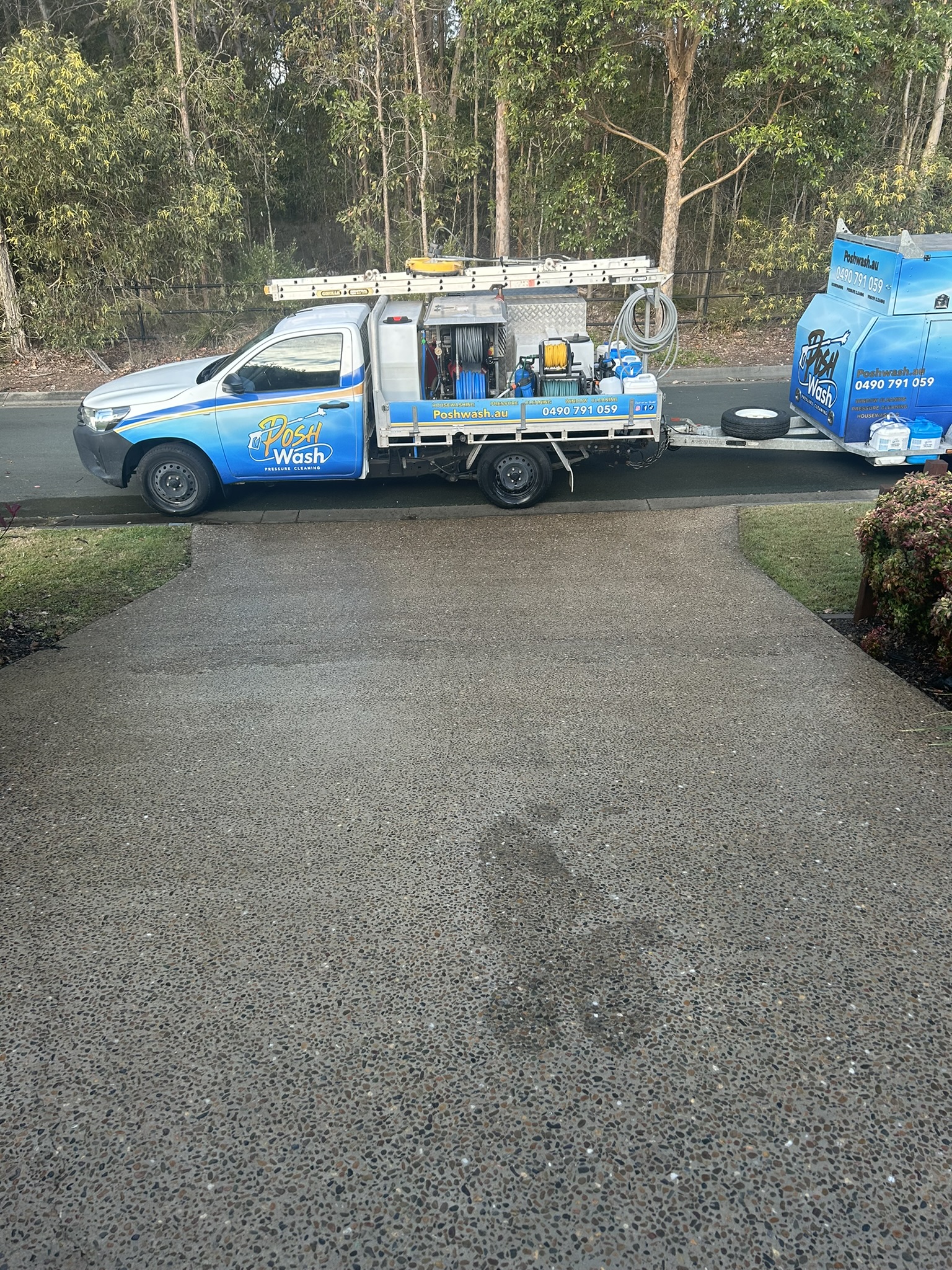
Lighter, not gone. If a cleaner shows you a driveway that came up spotless, look closely — the concrete has usually been ground back, acid etched or resurfaced, not cleaned.
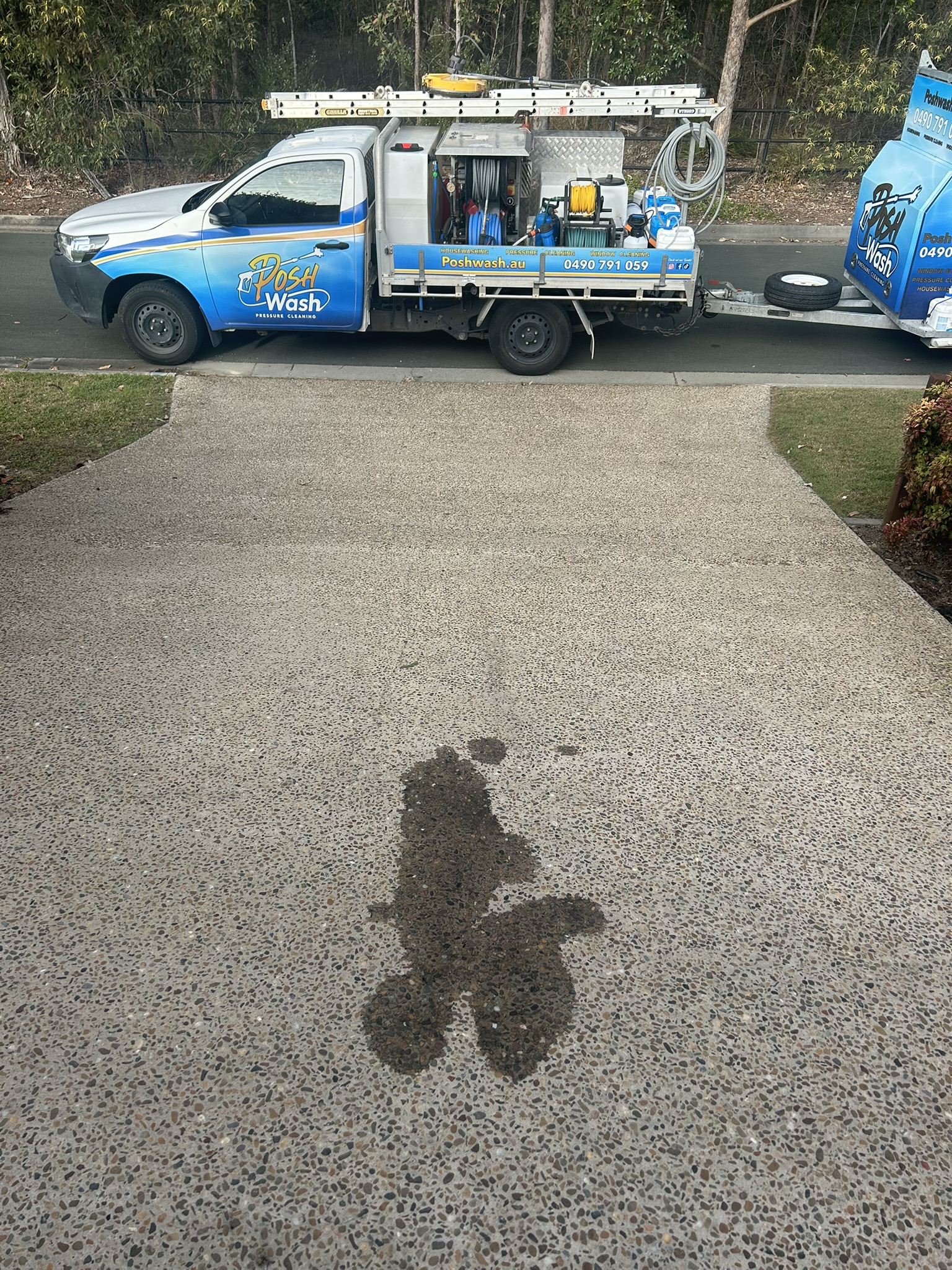
Oil stained concrete driveway before treatment
Before
The same oil stained driveway after degreasing and pressure cleaning, noticeably lighter but not fully removed
After
If you want us to try

What we actually do

  1. We look at it first
    Send a photo before you book anything. Nine times out of ten we can tell you from the photo whether it is worth attempting, and we will say so.
  2. Hot water and a dedicated degreaser
    The degreaser is left to dwell so it can break down what it can reach. Hot water does far more here than pressure does.
  3. Agitation, then a surface clean
    The stain is scrubbed rather than blasted, then the whole slab is surface cleaned so the finish is even edge to edge.
  4. A second pass if it is responding
    If the first application made a visible difference, a second is usually worth it. If it did nothing, a second will do nothing either, and we stop rather than charge you for it.

Oil treatment is normally added to a driveway or pressure clean rather than sold on its own — you get a clean driveway either way, and the stain is lighter than it was.

Better uses of your money

What we would suggest instead

Clean the whole driveway. A uniformly clean slab makes a stain read as a mark rather than as neglect. This is the single biggest visual improvement and it is the one that actually works.

Seal it afterwards. A sealed driveway is the only reliable defence. Once the sealer is down, the next spill sits on top of it and wipes away. It also keeps the concrete looking washed for far longer.

Deal with fresh spills fast. Cat litter or sand on a fresh spill, left overnight to draw the oil up, then a degreaser, will do more than anything we can do six months later.

If it truly has to go, it is a concreting job. Grinding, resurfacing or replacing the affected section is the only guaranteed fix. That is a job for a concreter, not a cleaner, and we will happily tell you that rather than take a booking we cannot deliver on.

Common questions

Straight answers

Can you get the stain out completely?
Almost certainly not, unless the surface is sealed or a closed pore tile. Expect lighter. Anyone promising gone is either resurfacing the concrete or overselling.
Will a stronger pressure washer work better?
No. Above roughly 3000 psi on concrete you start cutting the surface. That removes the top layer of concrete along with some stain and leaves visible wand marks and a patch that never matches.
What about acid or a rust remover?
Acids etch concrete. They can lighten a stain by removing the surface it is sitting in, but they leave the area rougher, lighter and more absorbent than everything around it — so the next spill goes in even deeper.
Do you charge if it does not work?
Oil treatment is priced as an add on to the driveway clean, so you are paying for the clean driveway you are getting. We will not quote a stand alone oil removal job that we do not believe in.
My real estate agent says it has to be removed before I hand back the keys.
Send us a photo. We can give you something in writing about what is and is not achievable on that surface, which is usually more useful to you than another attempt at cleaning it.
Send us a photo first

We will tell you honestly whether it is worth doing